

In oilfield logistics, last-mile delivery is where plans fall apart. The truck is loaded, the route is set, and then a gate code is wrong, a lease road is washed out, or the wellsite has no one to receive the load. The frac crew is waiting. The clock is running. And the cost of that delay compounds fast.
Last-mile delivery failures in oil and gas are rarely caused by one catastrophic breakdown. They are caused by dozens of small disconnects, between dispatch and drivers, between operators and carriers, between what the plan says and what the field actually looks like. Deloitte research shows last-mile delivery accounts for 30 to 35 percent of total logistics cost and that figure climbs even higher when basin sand is delivered directly. As the single largest cost driver in the chain, it’s also the highest-leverage point for technology intervention. Three solutions move the needle are:
Table of Contents
Solution 1: Real-Time Visibility That Reaches the Wellsite Gate
The most common last-mile delivery failure in oilfield operations is not a late truck. It’s a truck that arrives on time but cannot complete delivery because the coordinator or company man wants the security of loaded trucks stacked and waiting on the staging pad, the site is not ready, the gate is locked, or the receiving personnel have no warning the load is coming. That is a visibility problem. McKinsey estimates 13 to 19 percent of logistics costs stem from inefficient handoff interactions; and in oilfield operations, those handoffs happen hundreds of times per well completion.
Real-time supply chain visibility that extends from dispatch on through to proof of delivery changes this equation. LogistixIQ’s driver app connects both ends of the last mile with:
- Real-time load instructions and site protocols delivered directly to the driver
- Mobile proof of delivery and automated compliance tracking at the gate
- Instant communication between drivers and dispatch so exceptions get resolved in the field, not after the fact
- Wellsite supervisors with live load visibility who can stage receiving resources before the truck arrives
- A KPI driven map of trucks moving to the well and the storage on the well that delivers alerts
Solution 2: AI-Powered Dispatch That Accounts for Field Conditions
Oilfield last-mile delivery routes are not static. Common field realities that break generic dispatch systems include:
- Lease roads that wash out seasonally or after rain events
- Weight restrictions that change with the season or county
- Gate access procedures that vary by operator, shift, and site
AI-powered dispatch built for oilfield operations accounts for these variables. A purpose-built route planner app does not just optimize for distance. It adapts routes in real time based on road conditions, load type, and wellsite-specific access requirements. It routes drivers reliably to remote sites where standard navigation apps fail or send trucks down roads they cannot legally use.
With this optimization, AI can regulate the speed of the trucks to improve supply efficiency. In this way, less trucks are used, all drivers maximize their turns and load rates can be reduced. Most importantly, deliveries are assured and arrive on time to avoid queuing at the unload. This can reduce NPT by more than 50% and costs by as much as 20%.
LogistixIQ’s ManagedIQ plan takes this further. AI-enabled dispatchers routinely manage 10,000 loads per person per month by automating the routine decisions and escalating only the exceptions. That scale is not possible with manual dispatch, and it is where last-mile delivery throughput gains become measurable. LogistixIQ’s ManagedIQ plan delivers:
- 10,000 loads managed per dispatcher per month through AI-enabled automation
- Routine decisions automated and exceptions escalated; not the other way around
- $106,225 in frac-sand trucking savings per well from reduced deadhead miles and higher truck turn rates
Solution 3: NPT Prevention Through Demand and Supply Integration
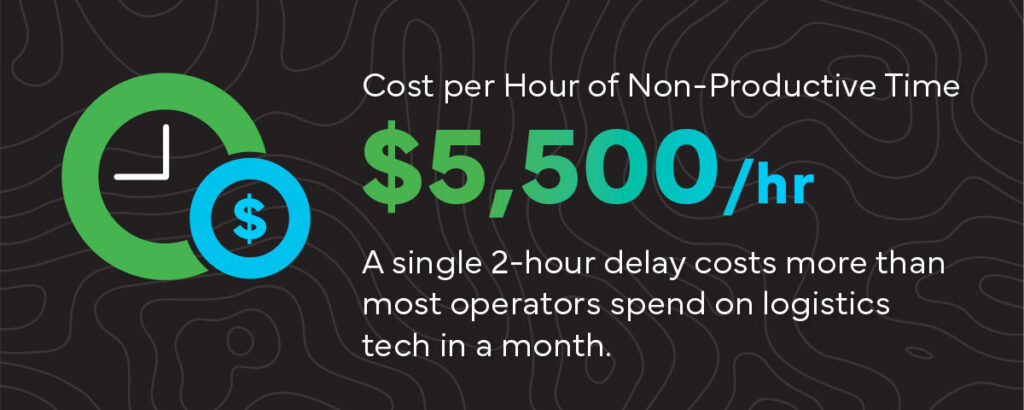
Non-productive time caused by last-mile delivery failures is one of the highest-cost line items in a well completion budget. At an estimated $5,500 per hour of NPT, a single delayed proppant delivery that idles a frac crew for two hours costs more than most operators spend on logistics technology in a month. The problem is that most NPT caused by delivery failures is predictable, but only if someone is watching the right signals in advance.
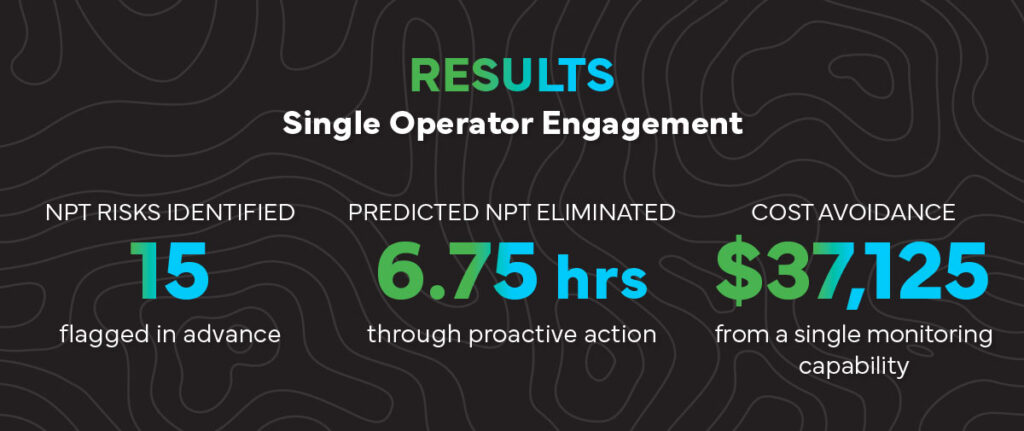
This is where demand and supply integration separates reactive logistics from proactive logistics. When a truck fleet management platform can see both the incoming supply chain and the wellsite’s real-time consumption rate, it can identify shortfalls before they become stoppages. LogistixIQ’s platform identified 15 NPT risks in advance on a single operator engagement, allowing the team to take proactive steps that eliminated 6.75 hours of predicted NPT. At $5,500 per hour, that is over $37,000 in cost avoidance from a single monitoring capability.
The operational logic is straightforward: last-mile delivery reliability improves when the platform can see far enough upstream to catch problems while there is still time to act. That requires integration across:
- Dispatch and carrier data
- Real-time asset and inventory tracking
- Wellsite consumption and demand signals, updated in real time
- Instant communication between the well, the carrier and the dispatcher
Last-Mile Delivery in Oilfield Logistics: By the Numbers
The cost of last-mile delivery failures in oil and gas is not theoretical. These figures come from active well completion operations across the South-Central U.S., documented through LogistixIQ platform data.
1,475 frac-sand truckloads per average well completion
Each one is a last-mile delivery event. Each one is an opportunity for a detention charge, a missed window, or an NPT event if the final leg breaks down.
$5,500 per hour of non-productive time (NPT)
A single delayed proppant delivery that idles a frac crew for two hours costs more than most operators spend on logistics technology in a month. NPT caused by last-mile delivery failures is preventable with the right visibility tools in place.
6.75 hours of predicted NPT eliminated on a single operator engagement
LogistixIQ identified 15 NPT risks in advance through demand and supply integration. Proactive intervention eliminated the majority before they became stoppages, generating $37,125 in cost avoidance on that well alone.
$106,225 saved per well in frac-sand trucking costs
Achieved through network optimization, automated dispatch, and coordinated communication that reduced deadhead miles and increased truck turn rates across a $1.16M per-well logistics spend.
25 to 30% average reduction in logistics operational costs across LogistixIQ clients
Most clients recoup their subscription costs within 60 days, driven by immediate trucking savings and back-office efficiency gains. The numbers reflect what happens when last-mile delivery is managed as a data problem, not a personnel problem.
Stop Managing Last-Mile Delivery by Reaction
The operators who consistently hit their completion schedules are not doing more. They are reacting less. They have:
- Platforms that surface problems early, before they become NPT events
- Dispatch tools that adapt to field conditions in real time, not after a call from the driver
- Visibility that reaches the wellsite gate rather than stopping at the distribution hub
LogistixIQ was built for this environment. From AI-enabled dispatch and real-time tracking to proactive NPT prevention, our platform gives oilfield operators the tools to turn last-mile delivery from a daily fire drill into a managed, measurable process. Contact us to see how LogistixIQ performs in your basin.